





Unlocking the Superior Performance of Solid-State Lasers: High-Power 885 nm Wavelength-Locked Diode Lasers


As semiconductor laser technology continues to mature and device performance improves significantly, it has strongly driven the rapid advancement of high-power all-solid-state lasers. Featuring high electro-optical conversion efficiency, compact size, lightweight structure, outstanding reliability and broad wavelength coverage, semiconductor lasers have become the core pumping sources for pumping laser systems such as fiber lasers and solid-state lasers.
Industry Pain Points
Restricted by inherent physical properties, conventional semiconductor lasers encounter critical technical bottlenecks. On one hand, their output wavelength drifts noticeably with changes in operating temperature and drive current. On the other hand, they feature a broad spectral linewidth of spontaneous emission. Wavelength drift and spectral broadening make it difficult for pump light to precisely match the absorption peak of gain media in solid-state lasers, which greatly reduces pump absorption efficiency and optical power stability. This has become a major obstacle to further performance improvement of high-power all-solid-state lasers.
Product Introduction
This 1800 W 885 nm wavelength-locked high-power semiconductor laser is a domestically developed high-end pump source tailored for solid-state laser pumping, advanced laser processing and other scenarios. Targeting the demands for high-efficiency pumping and superior spectral stability at 885 nm band, it overcomes the technical shortcomings of traditional devices in the same band, such as low output power, large heat loss and wide spectral linewidth.
Equipped with high-performance 885 nm single-emitter chips from DoGain, and combined with wavelength locking and high-power system integration technologies, the product achieves continuous output power ≥ 1800 W, central wavelength of 885±0.5 nm, spectral linewidth ≤ 1 nm, and electro-optical conversion efficiency ≥ 50%. It serves as an efficient replacement for traditional 808 nm pump sources, effectively improving the efficiency and stability of solid-state laser systems. Widely applied in precision laser processing, laser medical treatment and other fields, it features high energy efficiency, compact structure, high integration and excellent long-term operational stability.
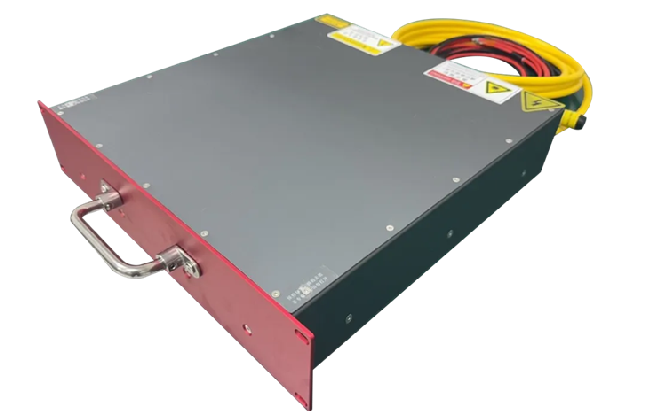
Appearance of 1800 W 885 nm Semiconductor Laser
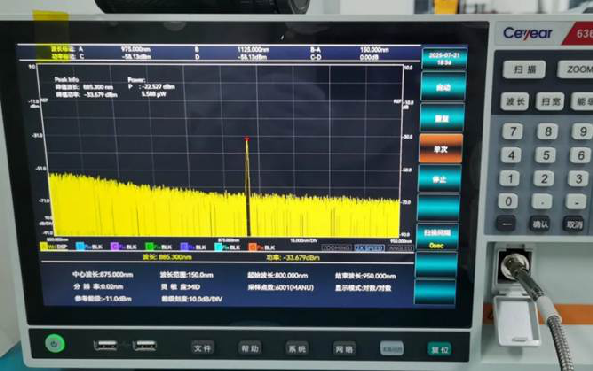
Spectral Test Diagram
Technical Innovations
1. High-Power Wavelength-Locked Fiber-Coupled Module Technology
The module integrates multiple high-power single-emitter chips. Adopting high-precision optical coupling design and automated manufacturing processes, it effectively cuts optical loss and light scattering to improve optical transmission efficiency. With Volume Bragg Grating (VBG) external cavity wavelength locking technology and high-efficiency heat dissipation structure, it realizes stable wavelength locking and constant power output across a wide temperature range and full current range within a compact space. The output beam features a flat-top spot with uniform energy and clear edges, meeting diverse application requirements.
2. Ultra-Compact Integration & Fully Domestic Independent Innovation
Built with an ultra-compact integrated architecture, the overall volume is 30% smaller than traditional solutions, enabling easy installation and flexible deployment in various scenarios. All core optoelectronic devices, optical components and structural parts are domestically produced with fully independent intellectual property rights, delivering outstanding advantages in supply chain security, cost control and customized service response.
3. High-Integration High-Efficiency Electrical Drive Innovation
The highly integrated power control module supports wide-voltage adaptive input. Featuring low-loss power devices and optimized topological structure, it reduces energy consumption by 15% compared with conventional drive solutions. Surge suppression and Electromagnetic Interference (EMI) mitigation are optimized at the circuit level to meet industrial-grade EMC requirements, ensuring more stable operation and stronger anti-interference capability.
4. High-Precision Intelligent Electronic Control & Networked Management
The electronic control system monitors real-time key parameters including current, voltage and temperature. With dynamic current modulation and precise pulse width adjustment, the output parameter control accuracy reaches ≤±0.5% and the response time is ≤50 μs. Embedded with fault early warning, automatic correction, over-temperature and over-current protection functions, it supports remote monitoring and bus communication for multi-unit collaborative control. It addresses the drawbacks of traditional equipment such as low precision, insufficient stability and complicated operation.
5. Modular High-Reliability Structure & Strong Environmental Adaptability
The modular design allows independent deployment or opto-electronic integration of optical and electronic control units. Optimized internal wiring and layout enhance heat dissipation and signal integrity, facilitating easy maintenance and component replacement. The integrated shockproof and sealed structure, together with high-strength lightweight alloy housing, provides excellent shock resistance and protection. It adapts to harsh industrial environments and delivers superior long-term operational reliability and environmental tolerance.
Industry Value
-
It raises the output power of 885 nm wavelength-locked semiconductor lasers and realizes independent control of core technologies, strongly driving the industrial upgrading of high-power all-solid-state lasers.
-
It boosts electro-optical efficiency. As a pump source for solid-state lasers, its efficiency is over 7% higher than that of traditional 808 nm pump sources. It greatly cuts energy consumption and operating costs of laser processing equipment, reduces temperature rise of crystals, improves processing accuracy and extends equipment service life, accelerating the high-efficiency and precision-oriented upgrading of the laser processing industry.
-
Expanding application boundaries, it empowers precision processing, laser medical treatment, scientific research and testing and many other fields with high power and superior stability. It promotes coordinated development of upstream and downstream optical component industries and drives diversified and high-quality growth of the laser industry, complying with the concept of green and sustainable development. Beyond improving the performance and efficiency of downstream equipment, it also fuels technological upgrading of advanced manufacturing, high-end medical and other industries, acting as a core optical power for high-end laser applications